Using Sensor Data to Coordinate Airport Operations
Managing an international airport terminal requires teams to respond to many changing conditions. A sudden queue surge at security, a drop in indoor air quality near a crowded gate, or a negative rating at a restroom feedback kiosk—these are real-time operational bottlenecks. Yet, traditional airport operations often rely on delayed manual reporting or fragmented systems.
To maintain peak operational efficiency and passenger satisfaction, airports are shifting toward sensor-driven workflow automation. Integrating IoT sensor networks directly with mobile workforce ticketing software can help route tasks to the appropriate team, depending on connectivity and configured assignment rules.
The Core Mechanism: How Sensor-Driven Ticketing Works
The primary challenge in modern airport operations is bridging the gap between data collection and operational execution. Airports collect vast amounts of telemetry, but without automated dispatching, data remains passive.

- Continuous Telemetry: IoT sensors throughout the terminal monitor environmental indicators, passenger volumes, and service ratings. For instance, in high-traffic airport terminals, footfall sensors detect when 500 passengers have passed through Gate B after a flight lands, triggering an automated cleaning ticket before the next boarding begins.
- Threshold Triggers: Custom business logic evaluates incoming streams against predefined operational thresholds.
- Automated Ticket Generation: When a threshold is breached, the engine creates a prioritised task without manual intervention.
- Targeted Push Dispatch: The task is sent to the responsible team through the mobile app, according to configured location, role and availability rules.
Primary Integration Scenarios & Operational Benefits
| Sensor Category | Operational Trigger | Automated Mobile Task | Business Impact |
A validated occupancy or queue indicator exceeds the configured threshold at security screening or a gate area. | Helps staff identify congestion and apply the airport's procedures for managing queues. | ||
| Real-Time Customer Feedback | Helps teams investigate issues reported by passengers sooner. | ||
| Air Quality & HVAC (CO2/VOC) | Spike in CO2 or VOC concentrations in crowded holding areas. | Supports monitoring of terminal conditions and helps identify areas that need investigation. |
Key Features Needed in a Next-Generation Airport Mobile App
To maximize the value of sensor automation, the employee mobile application must be tailored for high-intensity terminal environments:
- Role-Based Dynamic Routing: Pushes tickets based on staff availability, zone assignment, and technical skills (e.g., HVAC maintenance vs. custodial operations).
- Precise Indoor Location Context: Includes indoor positioning (BLE beacons/Wi-Fi) to pinpoint the exact location of the triggering sensor on interactive terminal maps.
- Audit Trails & SLA Tracking: Logs precise timestamps from sensor trigger to ticket acceptance, arrival, and resolution, creating actionable SLA data.Offline Working: Where supported, staff can record actions in areas with poor reception and sync them when connectivity returns.
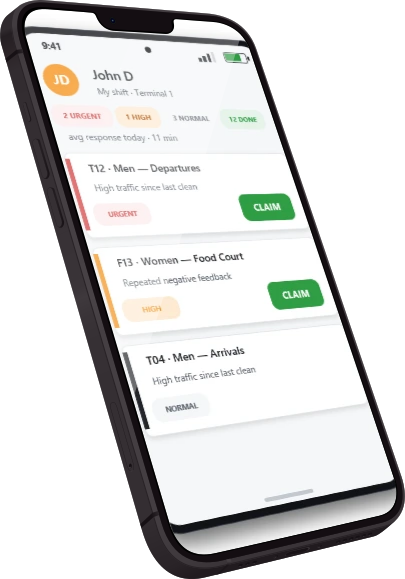
Transform Your Terminal Operations
Relying on manual reporting for routine terminal upkeep creates unnecessary delays, increases labor costs, and impacts the passenger experience. Sensor-driven mobile ticketing transforms raw operational data into immediate action on the terminal floor.
If you are looking to deploy a mobile workforce ticketing platform powered by IoT sensors, reach out to our team today for a technical demonstration and system architecture consultation.
If you manage airport facility operations, explore our dedicated Airport Cleaning & Operations App page to see full IoT integration in action
Contact Us for a Demo
For more information, a quotation or technical support, please use our contact form.
+40 314 32 00 35
Romania, Bucharest, District 1